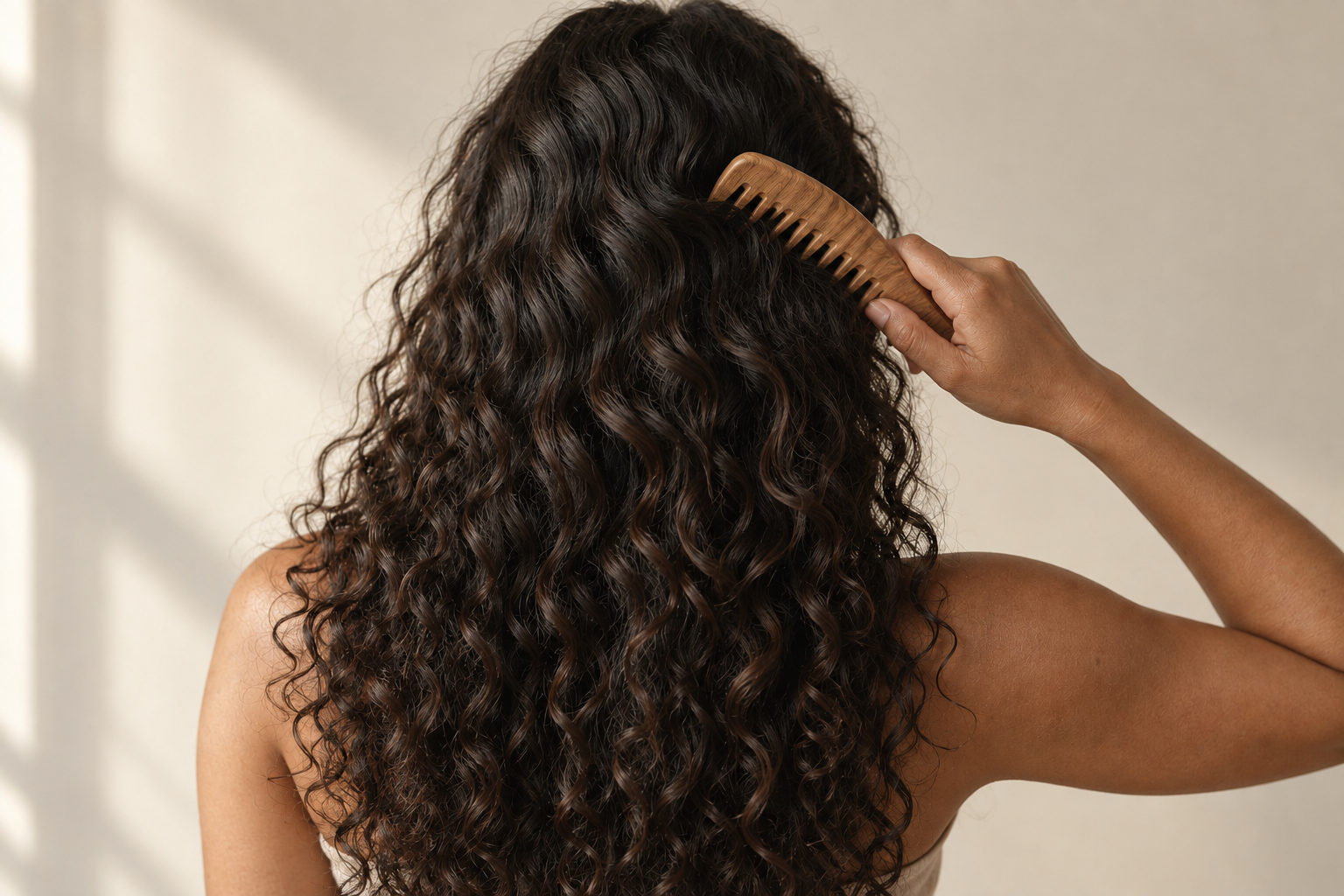
Sometimes hair does not fit neatly into one category. You may have waves in some areas, loose curls in others, and a pattern that changes depending on how you dry or style it.
To tell if your hair is wavy or curly, look at the shape it naturally forms. Wavy hair usually creates S-shaped bends, while curly hair tends to twist around itself into more noticeable loops or spirals.
What is the difference between wavy and curly hair?
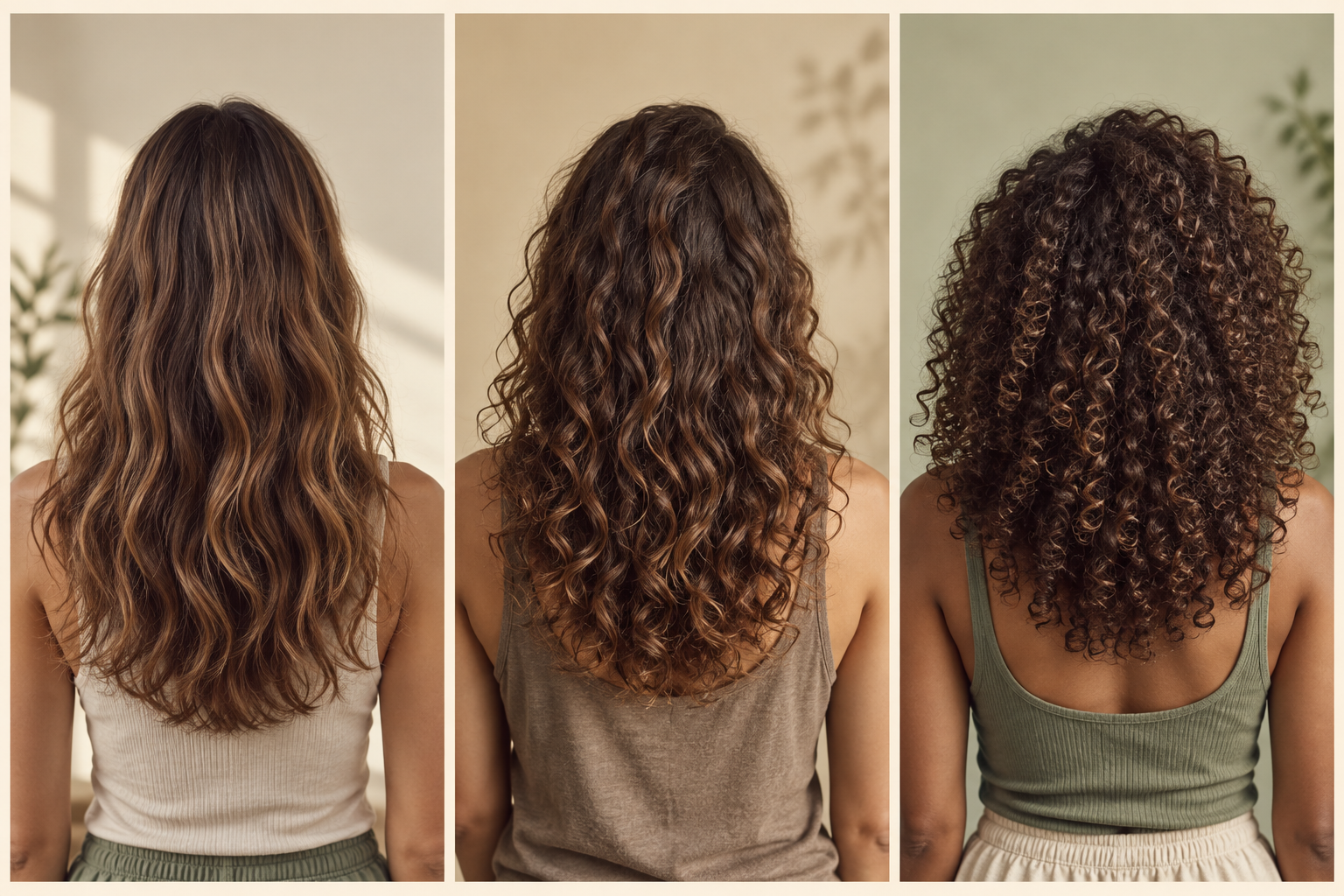
The main difference is the shape of the strand. Wavy hair tends to form S-shaped curves that do not fully loop around themselves, while curly hair has a stronger bend that creates more recognisable spirals or ringlets.
The line between the two is not always clear. It is completely normal for one head of hair to include defined waves, straighter areas and a few full curls.
In short: if the strand mainly forms an S shape, it is usually considered wavy. If it naturally forms a visible spiral or loop, it is closer to curly hair.
Signs that can help you identify your hair type
If your hair is wavy
- It forms soft or defined S-shaped bends.
- The pattern may begin further down the hair rather than directly at the roots.
- The ends may curve more strongly than the upper sections.
- Dry brushing can separate the waves and make them look less defined.
If your hair is curly
- It naturally forms spirals, loops or ringlets.
- Some strands complete a visible turn around themselves.
- The curl pattern often becomes more noticeable as the hair dries.
- Different areas can contain looser and tighter curls.
How to check your natural hair pattern
- Wash and condition your hair as usual.
- Detangle gently while your hair is still wet.
- Remove excess water without rubbing the hair.
- Let it dry without stretching it or repeatedly brushing it.
- Look at several sections, including the nape, sides, crown and hair around the face.
Try this over more than one wash. Styling products, humidity, brushing and drying techniques can temporarily change how your natural pattern looks.
What if I have both waves and curls?
That is completely possible. Hair typing systems can be useful as a guide, but many people naturally have more than one pattern.
Instead of focusing too much on a letter or number, pay attention to how your hair responds to cleansing, conditioning and styling. That information is often more useful when building a routine.
Is 2C hair wavy or curly?
In popular hair typing systems, 2C is generally placed at the more defined end of the wavy category, close to curly hair. It can include deep S-shaped waves as well as a few strands that form loose spirals. These classifications are useful guides rather than strict scientific categories.
How to care for wavy and curly hair
Both wavy and curly hair can benefit from good, well-balanced hydration. Keeping the hair properly conditioned can help it feel softer and more manageable while allowing its natural movement to show more clearly.
Cleanse and condition
Keep the scalp clean and follow cleansing with enough conditioning for your hair's needs. Finer waves may benefit from lighter amounts of product, while drier or thicker curls may prefer a richer conditioning step.
Style while the hair is damp
Apply your styling product to damp hair and gently encourage the strands to group together, working with the pattern that naturally appears rather than trying to force a different shape.
Dry without breaking up the pattern
Let the hair air-dry or use a diffuser at a moderate temperature, avoiding constant touching while it dries.
Boomerang: hydration for waves and curls
Whether your hair is wavy or curly, hydration is a good starting point when you want to keep the pattern flexible, comfortable and easy to manage. This is where the Boomerang line can fit naturally into a routine for waves and curls.
A simple routine can combine cleansing, a deeper conditioning step when your hair needs it, and leave-in care after washing. The important part is adapting the amount of product to your hair's density, strand thickness and individual response.
- Boomerang.Zero Shampoo: the cleansing step in a routine for wavy or curly hair.
- Boomerang.Zero Mask: an additional conditioning step when the hair needs more intensive care.
- Boomerang.Zero Leave In Cream: a leave-in step that can be incorporated after washing.
Remember that more hydration does not necessarily mean using more product. The aim is to find the amount that keeps waves or curls feeling conditioned without unnecessarily weighing down their natural movement.
FAQ about wavy and curly hair
Can wavy hair look curly with the right routine?
A suitable routine can make your natural pattern look more defined, but that does not necessarily mean wavy hair has turned into curly hair. Styling can help strands group together and reveal their natural shape more clearly without changing the underlying pattern.
Should I look at my hair wet or dry?
It is useful to look at both, although dry hair often gives a clearer picture of the finished pattern. The weight of water can temporarily stretch waves and curls, so watch how the shape changes as your hair dries.
Why is some of my hair wavy and some curly?
Because one head of hair can naturally contain several patterns. Length, strand thickness, the weight of the hair and styling methods can also influence how each section looks. It is usually more useful to consider the overall pattern than to classify every strand individually.
Your pattern is a guide, not a rule
Knowing whether your hair is wavy or curly can help you choose a routine that suits it better. Balanced hydration and a routine that respects your natural texture are often more useful than trying to fit every strand into one category.
Discover more at Greensoho.